
History is full of fascinating stories, but not all of them are true. Some are based on facts, others on exaggerations, and a few are simply misunderstandings that have been repeated for centuries.
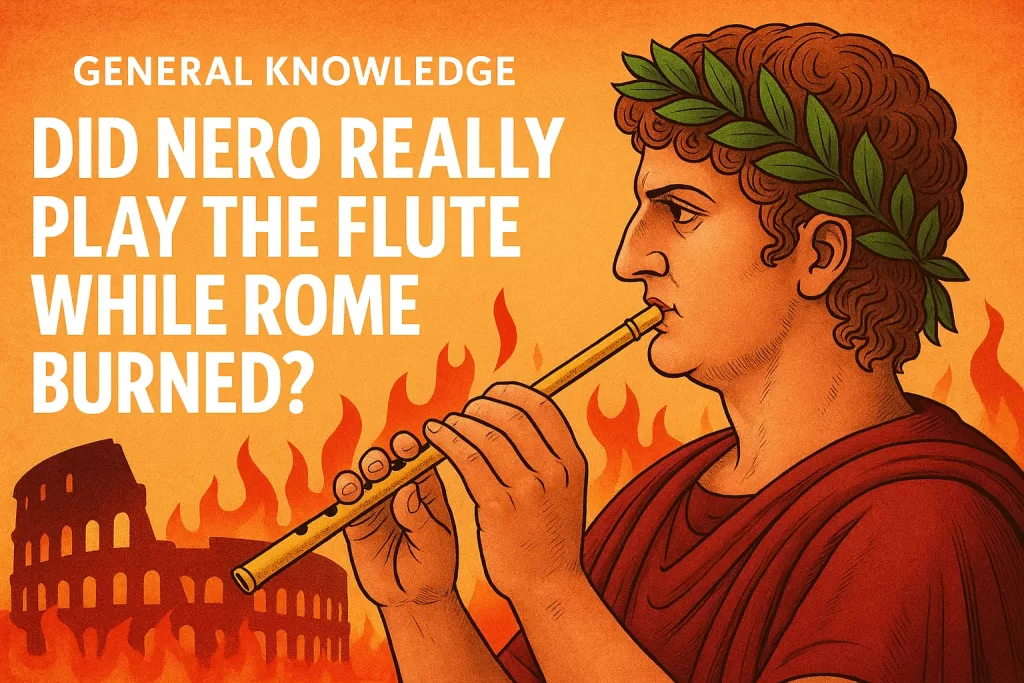
One of the most famous stories from ancient Rome is that Emperor Nero played the flute while the city burned.
But did this really happen? Or is it just a legend that grew over time? Let’s go deep into the history, step by step, so that by the end of this article, you’ll have no doubts left.
Read Also: Independence Day 2025: Gallantry Awards, Operation Sindoor & Their History
Who Was Emperor Nero?
Nero Claudius Caesar Augustus Germanicus, known simply as Nero, ruled the Roman Empire from AD 54 to 68.
He became emperor at the young age of 16, mainly due to the political influence of his ambitious mother, Agrippina the Younger.
At its height, the Roman Empire under Nero stretched from Spain in the west to Syria in the east, covering much of Europe, North Africa, and the Middle East.
Nero was unlike most emperors:
- He had a deep love for music, poetry, and theatre.
- He personally performed in public, which was considered undignified for a ruler at the time.
- He organised musical competitions and acted in plays.
- He was known to play the cithara, a stringed instrument similar to a lyre.
However, he was also infamous for cruelty. Ancient sources accuse him of killing his mother, stepbrother, and even one of his wives.
Read Also: Which Indian President Addressed the Nation Most on the Eve of Independence Day?
The Great Fire of Rome – 64 AD
The event that forever linked Nero’s name with the burning of Rome happened in July 64 AD.
How It Started
The fire broke out near the Circus Maximus, Rome’s largest chariot racing stadium. The exact cause remains unknown, but due to the city’s narrow streets and wooden buildings, flames spread rapidly.
Damage and Destruction
- The fire lasted for six days, then reignited and burned for another three days.
- Out of 14 districts in Rome, 10 were destroyed or badly damaged.
- Thousands of people were left homeless.
- Cultural and religious monuments were lost forever.
Read Also: Indian States With the Longest Highway Networks in 2025
The Famous Saying – “Nero Played the Flute”
The popular saying goes: “When Rome was burning, Nero played the flute.”
Today, people use this phrase to describe someone ignoring a crisis while focusing on something unimportant.
But there’s a problem with this story: the flute as we know it today didn’t exist in Nero’s time. The modern transverse flute appeared centuries later, around the 7th century AD.
So if Nero played any music, it couldn’t have been a flute. Ancient records suggest he played the lyre or cithara — string instruments that were popular in Rome.
Was Nero Really Playing Music During the Fire?
What the Sources Say
The main ancient historians who wrote about the fire were Tacitus, Suetonius, and Cassius Dio:
- Tacitus (writing about 50 years after the event) said there were rumors that Nero sang about the fall of Troy during the fire, but he admitted there was no solid proof.
- Suetonius and Cassius Dio wrote more dramatic accounts, claiming Nero may have dressed in stage costumes and performed while the city burned.
However, historians today agree that much of this may have been political propaganda. Many ancient writers disliked Nero and had reasons to paint him in a negative light.
Where Was Nero?
Some evidence suggests that when the fire started, Nero was not even in Rome — he was in Antium, about 35 miles away. Upon hearing the news, he returned to the city and:
- Opened public buildings and gardens for homeless citizens.
- Organised food distribution to prevent famine.
- Directed firefighting and rebuilding efforts.
Why People Blamed Nero
Despite his relief efforts, Nero’s reputation suffered for three main reasons:
- Urban Redevelopment Plans – After the fire, Nero built the grand Domus Aurea (Golden House), leading people to suspect he started the fire to clear space for it.
- Political Enemies – The Senate and aristocrats disliked his public performances and used the fire to discredit him.
- Rumors of Indifference – His passion for music made it easy for critics to spread the idea that he cared more about art than the city’s suffering.
Quick Facts Table
Question | Fact |
|---|---|
Year of the fire | 64 AD |
Length of fire | 9 days (including reignition) |
Districts destroyed | 10 out of 14 |
Instrument Nero played | Cithara / Lyre (not flute) |
Was he in Rome when fire started? | Likely in Antium |
Famous building after fire | Domus Aurea (Golden House) |
Truth vs Myth
Truth:
- Nero was a musician who played the cithara.
- He likely returned to Rome to help with relief efforts.
- He initiated rebuilding with new safety rules (wider streets, fire-resistant materials).
Myth:
- Nero played the flute while Rome burned. The flute didn’t exist in that form during his time.
- The story is more symbolic than factual — used to suggest neglect in times of crisis.
Why This Story Still Matters
Even if the story is a myth, its meaning lives on. The phrase “Nero fiddled while Rome burned” is now a metaphor for leaders who ignore urgent problems. It’s a reminder that during disasters, action matters more than personal pleasure.
Conclusion
No, Nero did not play the flute while Rome burned — because the flute didn’t exist in that form yet. If he played anything, it was likely the lyre or cithara. And whether he actually performed during the fire is still debated.
What we know for sure is that the story became a powerful legend, used to criticise Nero’s leadership and personality. Today, it’s less about historical truth and more about the timeless lesson: leaders must face crises head-on, not turn away from them.
Sources
- “Did Nero Really Fiddle While Rome Burned?” – History.com

I focus on crafting content for national and state government exams, aiming to simplify exam information for aspiring candidates, helping them gain clarity and confidence. With firsthand experience as a former aspirant, I offer a unique perspective in my work. My content covers a range of essential topics such as exam notifications, syllabi, admit cards, and results. You can find more detailed information at: www.sscgovtjobs.com