
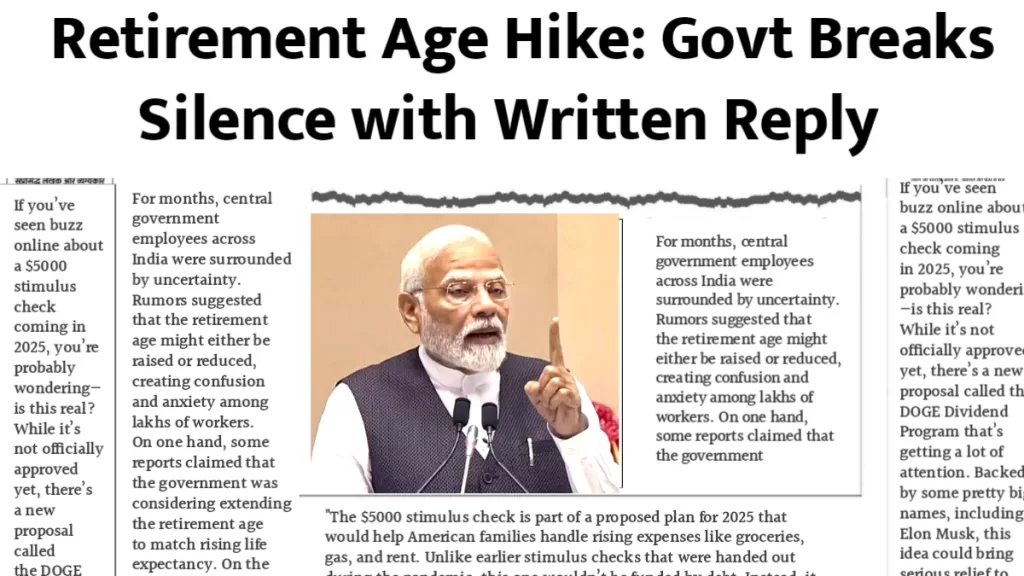
Retirement Age Hike 2025: For months, central government employees across India were caught in a cloud of uncertainty. Social media posts, office discussions, and speculative news reports suggested that the government was planning a retirement age hike or cut. Some reports claimed that retirement could be extended to 60 or even 62 years in line with rising life expectancy. Others hinted that the age might be reduced to 56 to create fresh vacancies for younger aspirants.
This constant buzz left lakhs of employees confused about their careers, pensions, and retirement planning.
Now, the government has finally broken its silence.
Government’s Written Clarification
In a written reply in Parliament, Union Minister Dr. Jitendra Singh stated clearly that there is no proposal to change the existing retirement age of central government employees.
This means the official retirement age will remain 58 years, putting an end to months of speculation.
The minister emphasized that the current framework already balances workforce requirements and employee welfare. Hence, there is no need to bring any new rules or amendments.
Why the Rumors Spread So Fast
Retirement age is a sensitive issue because it impacts both employees and job aspirants:
- For employees: A higher retirement age would mean more years of salary, allowances, and pension benefits. A lower age would create financial stress.
- For job seekers: A reduced age could open thousands of new vacancies, while an increase would delay fresh recruitment.
Because of these conflicting interests, even small unverified updates spread quickly, fueling unnecessary panic.
Current Rules on Retirement
According to existing rules, the retirement age for most central government employees is fixed at 58 years. In certain services or specialized departments, this may vary slightly, but the general structure has remained the same for years.
Employees also already have the option of Voluntary Retirement (VRS) under the Central Civil Services Pension Rules, 2021 and the All India Services (Death-cum-Retirement Benefits) Rules, 1958. This means that if someone wishes to retire earlier, they can do so without waiting for 58.
What the Clarification Means for Employees
The government’s official reply brings much-needed relief for central employees:
- Job security remains unchanged – they can continue working until 58 without fear of sudden changes.
- Career planning is easier – employees can plan pensions, promotions, and retirement life with confidence.
- No disruption in workforce – promotions and new vacancies will continue to open up naturally.
For younger aspirants, however, this also means there won’t be a sudden wave of vacancies through early retirements.
Why the Government Maintained Status Quo
By keeping the retirement age at 58, the government is trying to balance three things:
- Experienced staff: Senior employees continue to contribute knowledge until a stable exit point.
- Younger workforce: Vacancies open up gradually instead of suddenly, avoiding instability.
- Financial stability: Raising retirement age would mean longer salary payouts, while reducing it could create a sudden pension burden.
This decision helps maintain equilibrium in both workforce planning and the government’s financial commitments.
No New Rule Planned
The minister’s written reply also confirms that no new schemes are being planned regarding retirement. Employees can either continue till 58 or opt for voluntary retirement earlier if they wish.
This clarification shuts down all ongoing speculation and ensures stability for both employees and job aspirants.
Link with 8th Pay Commission
While retirement age is not changing, central employees are now looking forward to the 8th Pay Commission, expected in 2026. This commission is likely to recommend changes in salary, pension, and allowances, which could bring financial relief even without a shift in retirement policy.
Final Word
The official statement makes one thing very clear: Retirement age for central government employees remains fixed at 58 years.
For employees, this brings peace of mind after months of rumors. For aspirants, it is a reminder to prepare for opportunities within the existing system rather than expecting sudden vacancies.
The speculation may be over, but the bigger focus now shifts to the upcoming 8th Pay Commission and what it may bring for the workforce.

I focus on crafting content for national and state government exams, aiming to simplify exam information for aspiring candidates, helping them gain clarity and confidence. With firsthand experience as a former aspirant, I offer a unique perspective in my work. My content covers a range of essential topics such as exam notifications, syllabi, admit cards, and results. You can find more detailed information at: www.sscgovtjobs.com