
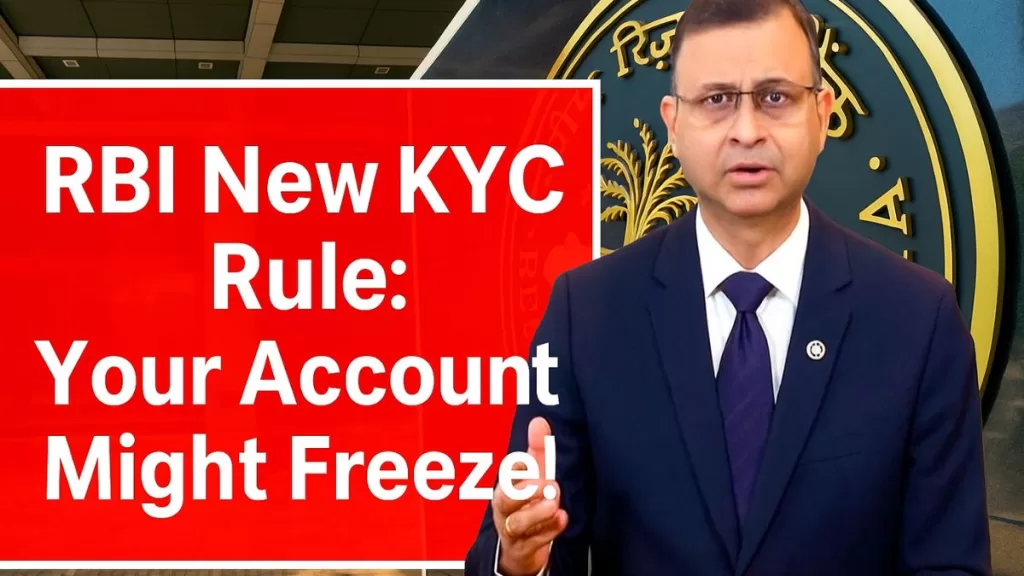
If you have a bank account with SBI, PNB, HDFC, Axis Bank, ICICI, or any other Indian bank, there’s an important update you cannot afford to miss. The Reserve Bank of India (RBI) has introduced a new rule in 2025 that makes KYC (Know Your Customer) compliance mandatory for all account holders.
The deadline is fixed: October 10, 2025. If you fail to complete your KYC before this date, your account could face restrictions or even get frozen.
What is KYC and Why Has RBI Made it Mandatory?
KYC means Know Your Customer. It is a process used by banks to verify your identity and address. While KYC has always been part of banking, the RBI has now made it stricter to:
- Prevent fraud and identity theft
- Stop illegal money laundering activities
- Ensure transparency and secure banking for everyone
Earlier, some customers ignored KYC after opening their account. Under the new RBI guideline, every account must have updated KYC within one year of opening, and periodic updates will also be required depending on the type of account.
What Will Happen If You Don’t Update KYC?
The consequences are serious if you miss the October 10 deadline:
- Transaction restrictions – You won’t be able to withdraw or transfer money.
- Account freeze – Your account could be blocked completely.
- Limited access – Deposits and other banking services may stop.
This can be a major problem if your account is linked to your salary, pension, subsidies, or EMI payments. For many families, especially in small towns and rural areas, the bank account is the only lifeline for daily financial needs.
How to Check If Your KYC is Complete
Most banks have started sending SMS alerts, emails, and app notifications. You can also check your status easily:
- Through your mobile banking app
- On the bank’s official website
- By calling the customer care helpline
- Or simply by visiting your nearest branch
How to Complete KYC
RBI has made the process simple. You can do it online or offline:
Online KYC
- Log in to your bank’s mobile app or net banking.
- Upload scanned copies of your Aadhaar, PAN, or Passport.
- Some banks also offer video KYC for faster verification.
Offline KYC
- Visit your nearest branch.
- Carry a valid photo ID (Aadhaar, PAN, Passport, Voter ID).
- Bring address proof (utility bill, Aadhaar, ration card).
- Provide your account details or passbook.
The bank staff will verify your documents and mark your KYC as complete. For low-risk accounts, some banks may accept self-declaration as well.
Why Completing KYC is Important
KYC is not just a formality. It protects you and your money. By completing it on time, you can:
- Keep full and smooth access to your account
- Protect your funds from fraud and misuse
- Avoid disruptions in essential payments
- Stay legally compliant with RBI guidelines
RBI’s Deadline: October 10, 2025
The RBI has set October 10, 2025 as the final date for compliance. If your KYC is incomplete, act immediately. Don’t wait till the last moment, because account verification at branches may take time due to heavy rush near the deadline.
Final Word
The RBI New KYC Rule 2025 is a reminder that banking is moving towards stricter rules and more transparency. Whether you have a savings account, salary account, or even a zero-balance account, you must complete KYC before the deadline.
Disclaimer
This article is for informational purposes only and does not constitute financial advice. The details mentioned are based on official updates and publicly available RBI guidelines as of 2025. Rules and deadlines may change, and different banks may have their own procedures for KYC compliance. For the most accurate and updated information, account holders are advised to check directly with their bank or visit the official Reserve Bank of India (RBI) website.

I focus on crafting content for national and state government exams, aiming to simplify exam information for aspiring candidates, helping them gain clarity and confidence. With firsthand experience as a former aspirant, I offer a unique perspective in my work. My content covers a range of essential topics such as exam notifications, syllabi, admit cards, and results. You can find more detailed information at: www.sscgovtjobs.com