
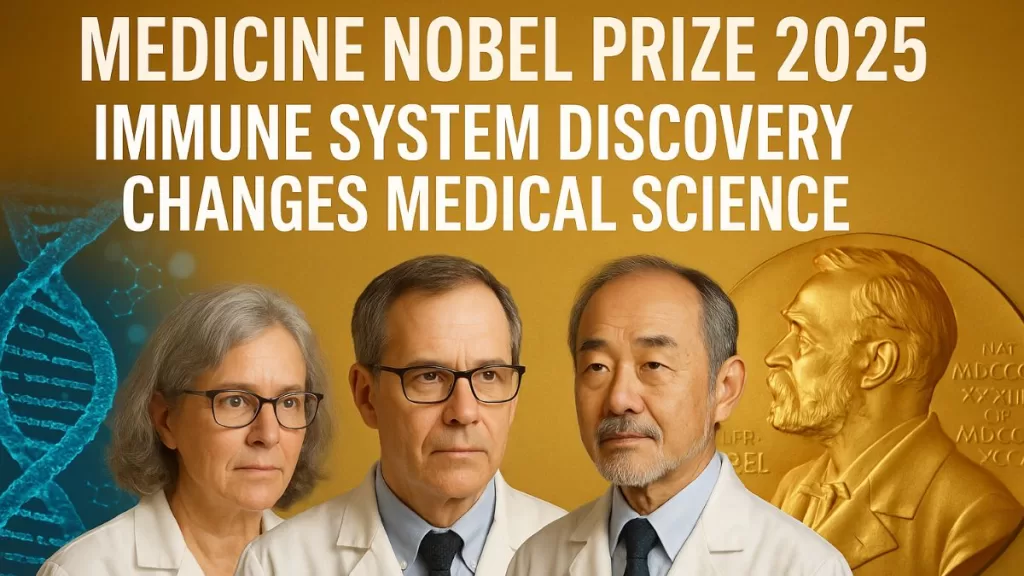
Medicine Nobel Prize 2025: The Nobel Prize 2025 in Physiology or Medicine has been awarded to three pioneering scientists — Shimon Sakaguchi, Fred Ramsdell, and Mary E. Brunkow — for their groundbreaking discoveries in peripheral immune tolerance, a mechanism that helps the body distinguish between self and non-self cells.
Their findings have transformed the understanding of the human immune system and opened new avenues for treating autoimmune diseases, cancer, and organ transplant complications. This year’s Nobel Prize for Medicine 2025 highlights how fundamental research can revolutionize clinical medicine.
What is Peripheral Immune Tolerance and Why It Matters
The immune system plays a dual role — protecting the body from harmful invaders while maintaining peace with its own tissues. This delicate balance is achieved through peripheral immune tolerance.
The Medicine Nobel Prize 2025 winners discovered that a special group of cells called regulatory T cells (T-regs), controlled by the FOXP3 gene, ensures the immune system doesn’t mistakenly attack the body itself.
When this process fails, it can lead to autoimmune diseases such as Type 1 diabetes, lupus, or rheumatoid arthritis. Their work not only explained why these diseases occur but also suggested new therapeutic approaches to manage them.
Shimon Sakaguchi Nobel Prize 2025: The Discovery of Regulatory T Cells
In 1995, Japanese scientist Shimon Sakaguchi proposed that the immune system contains a special type of “regulatory” cells that act as a brake, preventing overreaction. These cells, known as T-regs, help maintain immune balance.
His research provided a major breakthrough, revealing how the immune system controls its own aggression. The recognition of Shimon Sakaguchi Nobel Prize underscores his lifelong contribution to understanding immune tolerance and regulation.
Fred Ramsdell and Mary E. Brunkow: Unlocking the FOXP3 Gene
While Sakaguchi identified the concept of regulatory T cells, American researchers Fred Ramsdell and Mary E. Brunkow uncovered the genetic foundation that makes them possible.
In 2001, they discovered that the FOXP3 gene is crucial for the development and function of these T-regs. Mutations in this gene lead to severe autoimmune conditions, confirming its central role in peripheral immune tolerance.
The collaboration between Fred Ramsdell and Mary E. Brunkow connected cellular biology with genetics, completing a key puzzle in immunology. Today, Mary E. Brunkow is recognized globally for her contributions to immune research and precision medicine.
How the Medicine Nobel Prize 2025 Will Transform Healthcare
The discoveries honored by the Nobel Prize medicine award are already influencing research and treatment strategies across the world.
1. Autoimmune Disease Treatment
Therapies that activate regulatory T cells could help control overactive immune responses, offering hope for patients with lupus, multiple sclerosis, and Type 1 diabetes.
2. Cancer Immunotherapy
By temporarily reducing T-reg activity, doctors can enhance the immune system’s ability to target and destroy cancer cells, leading to more effective immunotherapies.
3. Organ Transplantation
A deeper understanding of immune tolerance may help prevent organ rejection, making transplants safer and more successful.
Nobel Prize Winners 2025 – Quick Overview
Category | Winners | Key Contribution |
|---|---|---|
Medicine / Physiology | Shimon Sakaguchi, Fred Ramsdell, Mary E. Brunkow | Discovery of peripheral immune tolerance via regulatory T cells and FOXP3 gene |
This year’s Nobel Prize 2025 once again highlights how deep scientific insight can lead to tangible progress in medicine and patient care.
Mary E. Brunkow: A Leading Voice in Immunology
Among the laureates, Mary E. Brunkow stands out for her genetic research that revealed how the FOXP3 gene orchestrates immune tolerance. Her work emphasizes the critical role of women in advancing global biomedical research.
By combining laboratory science with clinical potential, Mary Brunkow has become a symbol of perseverance and precision in modern immunology.
Why the Nobel Prize 2025 Matters More Than Ever
With the rise in autoimmune disorders and the growing need for personalized medicine, the work of Shimon Sakaguchi, Fred Ramsdell, and Mary E. Brunkow offers new hope for millions.
Their research shows that the immune system’s natural balance can be restored — not by suppression, but by understanding and guiding it. The Nobel Prize winners 2025 have shown that unlocking the immune system’s “control switch” can change how we fight disease forever.
In Summary
The Medicine Nobel Prize 2025 honors Shimon Sakaguchi, Fred Ramsdell, and Mary E. Brunkow for their groundbreaking research on peripheral immune tolerance — one of the most vital discoveries in human biology.
Their work revealed how regulatory T cells and the FOXP3 gene maintain immune balance, paving the way for breakthroughs in autoimmune disease treatment, cancer therapy, and organ transplantation.
As the world celebrates the Nobel Prize for Medicine 2025, one thing is certain — these discoveries will continue to guide scientific innovation and medical progress for generations to come.

I focus on crafting content for national and state government exams, aiming to simplify exam information for aspiring candidates, helping them gain clarity and confidence. With firsthand experience as a former aspirant, I offer a unique perspective in my work. My content covers a range of essential topics such as exam notifications, syllabi, admit cards, and results. You can find more detailed information at: www.sscgovtjobs.com